Documento Mês – Fundos e Coleções
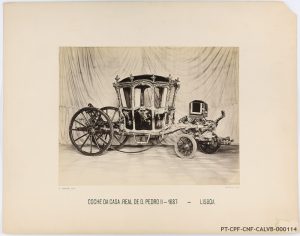
Coche da Casa Real de D. Pedro II – 1887 – Lisboa
Viatura de aparato com decoração de talha dourada em estilo francês de Luís XIV
PT/CPF/CNF-CALVB/000114
D. Pedro II, filho de D. Pedro IV de Portugal (o imperador D. Pedro I do Brasil) e de D. Maria Leopoldina, nasceu em 1825 e faleceu em 1891. O seu pai foi obrigado a abdicar em seu favor em 1831. A 23 de julho de 1840, após um período de grande agitação política, D. Pedro II foi declarado maior e coroado. Em 1843 casou-se, por procuração, com a princesa Teresa Cristina de Bourbon.
Durante o seu reinado, viajou pela Europa, pelos Estados Unidos e pelo continente africano, com especial destaque para o Egito. Durante as suas ausências, a princesa imperial D. Isabel assumia a regência, sendo ela quem, em 1888, declarou a abolição da escravatura no Brasil.
D. Pedro II destacou-se pelo seu amor às artes e às ciências, às quais dedicava mais tempo do que à política, protegendo e patrocinando os estudos daqueles que procuravam aperfeiçoamento artístico na Europa. No Brasil, quando foi proclamada a República em 1889, encontrava-se doente e afastado da vida política.
Em 1920, com a revogação da lei que bania a família imperial, os restos mortais do imperador e da sua esposa foram transferidos do Panteão de São Vicente de Fora, em Lisboa, para a catedral da cidade de Petrópolis, onde se encontram atualmente.
Dom Pedro II, son of Dom Pedro IV of Portugal (Emperor Dom Pedro I of Brazil) and Dona Maria Leopoldina, was born in 1825 and died in 1891. His father was forced to abdicate in his favour in 1831. On July 23, 1840, after a period of great political unrest, Dom Pedro II was declared of age and crowned. In 1843, he married Princess Teresa Cristina of Bourbon by proxy.
During his reign, he travelled through Europe, the United States, and the African continent, with particular emphasis on Egypt. During his absences, the Imperial Princess Dona Isabel assumed the regency, and it was she who, in 1888, declared the abolition of slavery in Brazil.
Dom Pedro II stood out for his love of the arts and sciences, to which he devoted more time than to politics, supporting and sponsoring the studies of those seeking artistic improvement in Europe. When the Republic was proclaimed in Brazil in 1889, he was ill and already withdrawn from political life.
In 1920, with the repeal of the law that had exiled the imperial family, the remains of the emperor and his wife were transferred from the Pantheon of São Vicente de Fora in Lisbon to the cathedral in the city of Petrópolis, where they are currently buried.
Francesco Rocchini
Royal Carriage of Dom Pedro II – 1887 – Lisbon
Ornate vehicle with golden woodcarving decoration in the French style of Louis XIV.
PT/CPF/CNF-CALVB/000114